Selection principle
Compare the Complete Fixture, Not LED Multiplication
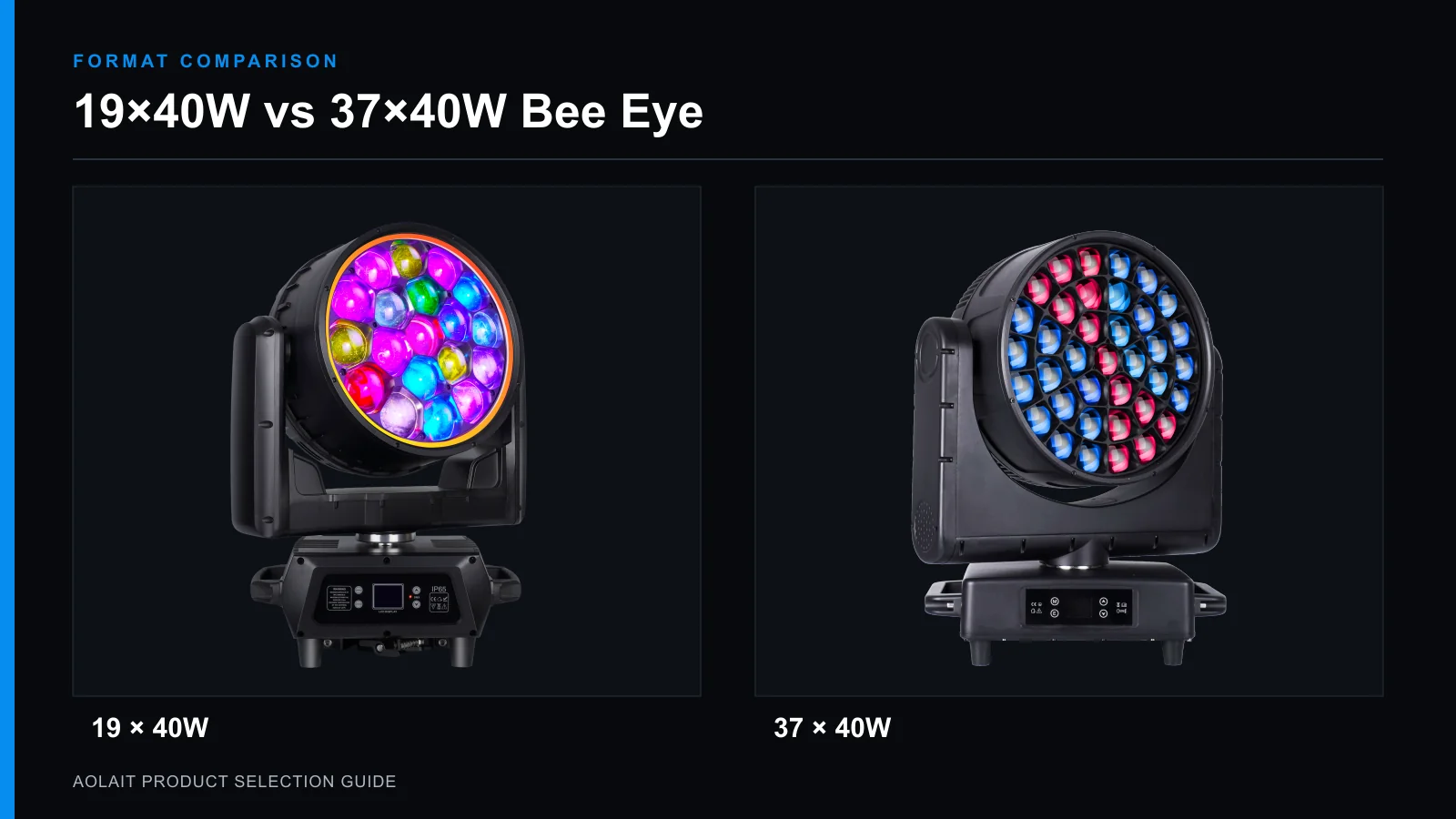
A 19×40W label describes nineteen rated LED packages; a 37×40W label describes thirty-seven. Neither label is a photometric result.
LED count multiplied by rated LED wattage does not equal measured fixture output. Optical transmission, drive current, thermal management, zoom position, lens geometry, color mix and measurement method all affect the result. Without comparable test data from the same method, it is inaccurate to call a 37-cell fixture twice as bright as a 19-cell fixture.
The useful comparison is architectural: optical-face size, number of controllable cells, zoom range, movement, DMX footprint, rated fixture power, physical size, net weight, ingress protection and the work the fixture must perform.
Short definition
What Is a Bee Eye Moving Head?
A Bee Eye moving head presents a visible multi-lens LED face that can combine wash coverage with audience-facing patterns and optical motion.
The defining elements are the clustered lens face, motorized movement and a control system that can treat the cells together, in groups or individually according to the model and DMX personality. Motorized zoom changes the beam-to-wash relationship. Selected fixtures add continuous front-lens rotation and built-in shape engines.
For the full product range, use the Aolait Bee Eye moving head category. This article stays focused on 19-cell versus 37-cell selection and the IP20/IP65 decision.
Nineteen-cell formats
19×40W Bee Eye Moving Heads
Aolait has indoor and IP65 19-cell platforms, so the LED count alone does not define enclosure, zoom, power or control.
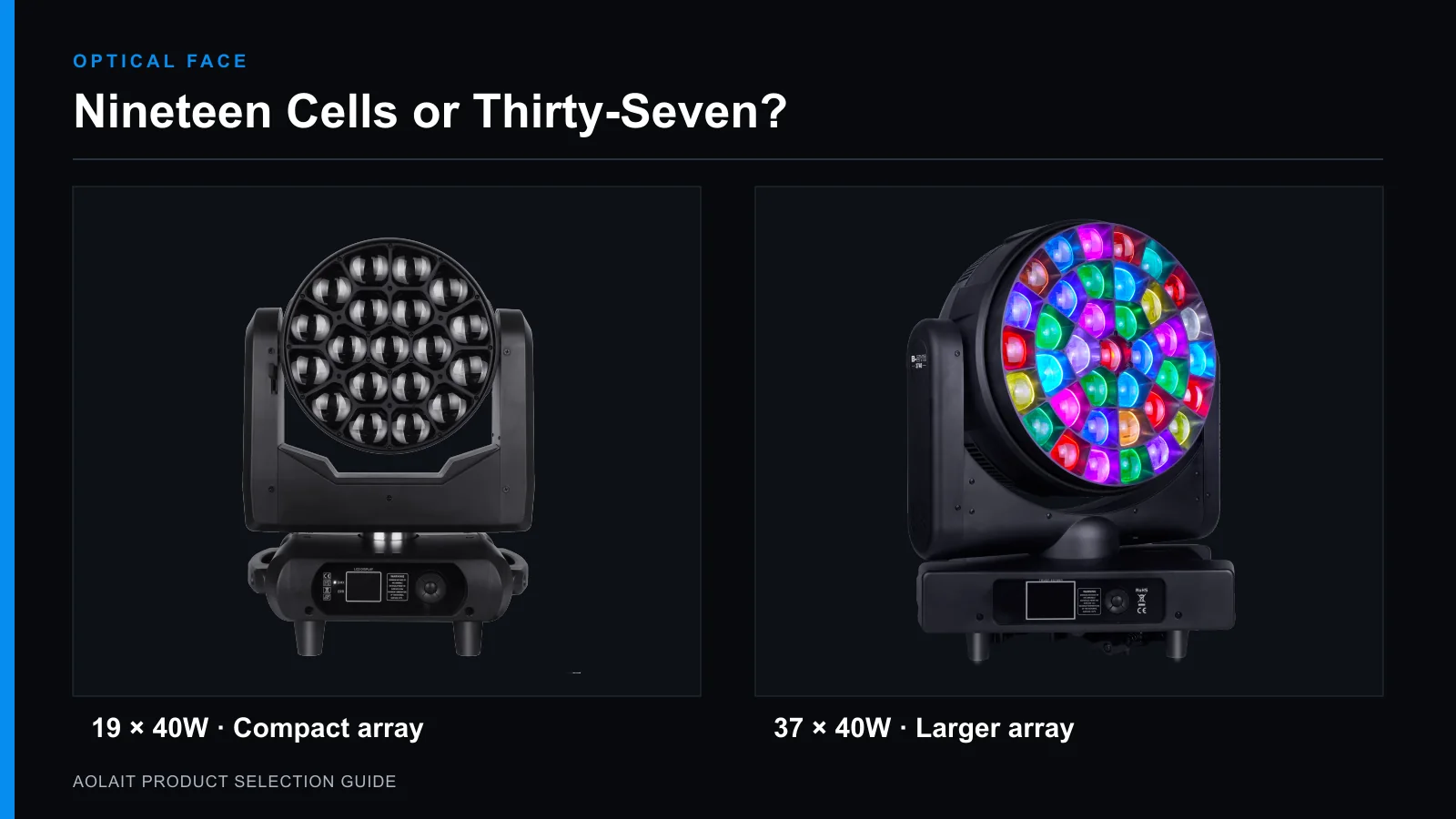
The AL1940WR uses nineteen 40W RGBW cells, 4°–60° motorized zoom, continuous front-lens rotation and five DMX personalities from 21CH to 97CH. It is a dry-indoor 500W platform with 540°/270° movement.
The AL1940WP is a separate 19-cell IP65 platform with 7°–42° zoom, individual-cell control, six DMX personalities, 850W rated power and 22kg net weight. This makes 19×40W a format choice, not a single fixed specification.
Nineteen-cell models can suit rental inventory, clubs, venues and medium-stage work when their optics, rigging load and control modes fit the design. Confirm case arrangement and the exact personality before standardizing a fleet.
Thirty-seven-cell formats
37×40W Bee Eye Moving Heads
Moving from nineteen to thirty-seven cells changes the optical face, fixture scale, channel plan and electrical requirements.
The indoor AL3740WR combines thirty-seven 40W RGBW cells with 7°–50° zoom, continuous front-lens rotation and six DMX personalities. Its 169CH mode exposes RGBW data for all 37 cells. The fixture is IP20, rated at 1,450W, measures 496 × 293 × 590mm and weighs 26kg.
The IP65 ALP3740WR uses a 37×40W RGBW engine, 8°–48° zoom, continuous lens rotation and six DMX personalities. It is rated at 1,450W, measures 530 × 279.5 × 663mm and weighs 32.2kg.
The larger luminous surface and additional cells can create a stronger audience-facing visual presence and more pixel positions. They also require a larger rigging, transport and channel-planning allowance. Treat those trade-offs as part of the system design.
Model comparison
19×40W vs 37×40W: Model-Based Comparison
These published Aolait models show why the format should be compared through exact specifications rather than a generic winner.
| Model | LED / zoom | Pixel and control | Protection / power | Size and weight |
|---|---|---|---|---|
| AL1940WR | 19×40W RGBW; 4°–60° | 19-cell access in extended modes; 21/35/78/92/97CH | Dry indoor; 500W | Mini-format indoor platform |
| AL1940WP | 19×40W RGBW; 7°–42° | Individual cell control; six personalities | IP65; 850W | 22kg; use model drawing for dimensional planning |
| AL3740WR | 37×40W RGBW; 7°–50° | 37-cell RGBW access in 169CH; six personalities | IP20; 1,450W | 496×293×590mm; 26kg |
| ALP3740WR | 37×40W RGBW; 8°–48° | Extended pixel personalities; six personalities | IP65; 1,450W | 530×279.5×663mm; 32.2kg |
When a 19×40W format is more practical
Choose a 19-cell candidate when the stage and audience sightline do not require the larger 37-cell face, or when lower fixture mass, case density, power allocation and channel count carry more value. The exact benefit depends on the selected indoor or IP65 model.
When a 37×40W format is more practical
Choose a 37-cell candidate when the larger optical face, additional pixel positions and large-format stage presence serve the show design, and the rig, power distribution, transport system and console can support it.
Environment decision
IP20 vs IP65 Bee Eye: AL3740WR and ALP3740WR
The two 37-cell models create a clear comparison between controlled indoor work and outdoor-event requirements.
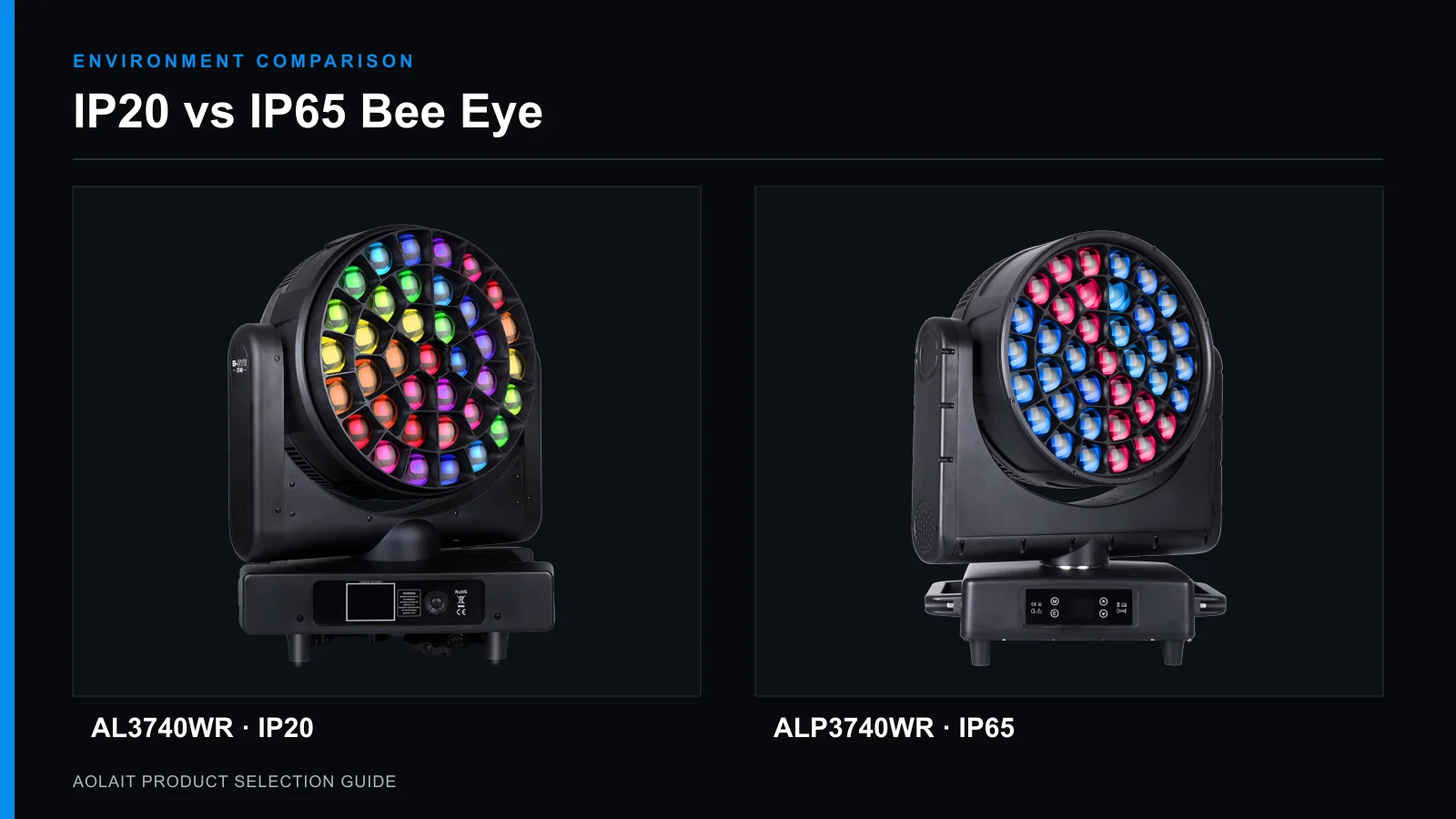
AL3740WR fits dry indoor venues, clubs, theatres and controlled rental work where the complete installation keeps the fixture away from water exposure. ALP3740WR adds an IP65 enclosure designation for touring, festivals and outdoor events where dust and temporary weather exposure are real planning variables.
IP65 does not mean permanent outdoor installation, immersion protection or freedom from maintenance. Confirm caps, connectors, seals, operating instructions, drainage, power and data distribution, weather monitoring and the current model documentation for the complete deployment.
For a deeper enclosure decision, read IP65 vs IP20 Moving Head Wash and What Does IP65 Mean for Outdoor Stage Lighting?.
Application logic
Which Bee Eye Configuration Fits Your Application?
Use the application to narrow the format, then evaluate the exact model and sample.
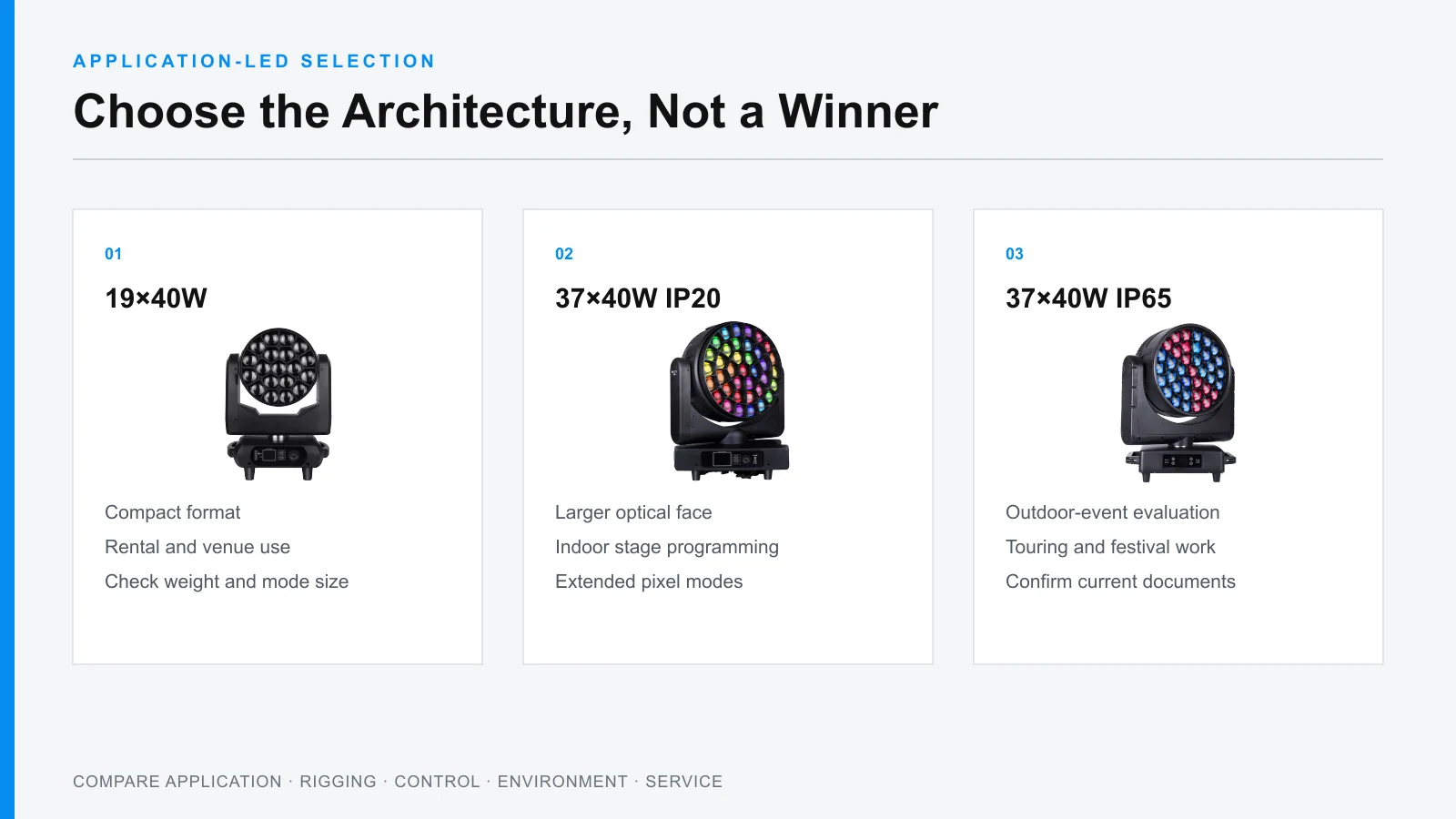
- Rental company
- Compare booking mix, case density, crew lifts, spares, turnaround time and console profiles. A mixed 19-cell and 37-cell inventory may be more useful than one universal format.
- Touring production
- Balance optical-face impact and pixel programming against rigging, power, universe count and transport. Add IP65 when exposed outdoor work is part of the route.
- Club or venue
- Measure room size, trim height, mounting position and sightline. Assess effects, zoom, noise and maintenance access on a sample.
- Theatre
- Test wash quality, dimming, color, zoom and fan behavior in the room. A large pixel face adds value only when the production uses it.
- Festival or outdoor event
- Start with ingress protection and the weather plan, then compare rigging, control and optics. IP65 does not replace system-level protection.
- Distributor
- Map demand by environment, stage scale, power and programming capability. Confirm spare parts, service training, documents and positioning before stocking.
Project checklist
Questions to Ask Before Selecting a Bee Eye
Ask the same questions for every candidate so the quotation and sample check stay comparable.
- What LED engine and color system does the exact model use?
- What is the documented zoom range?
- Can the cells be controlled individually, and in which personality?
- How many DMX modes are available, and how many universes will the rig require?
- Does the exact production version support RDM or network control?
- Is the fixture intended for dry indoor work or documented IP65 use?
- What are the fixture dimensions, net weight and packed dimensions?
- What is the rated maximum power consumption?
- Which flight-case options, clamps and accessories are included in the quotation?
- Which spare parts and service procedures are available?
- Which model-specific documents and certificates are supplied?
- What warranty and remote technical support apply to the order?
If color-system selection is also part of the project, use the RGBL vs RGBW guide. For universe planning, continue with the fixture-profile validation guide.
RECOMMENDED PRODUCTS
Models to evaluate against your brief
We organize model-specific product facts and available technical files to support fixture comparison and project planning.
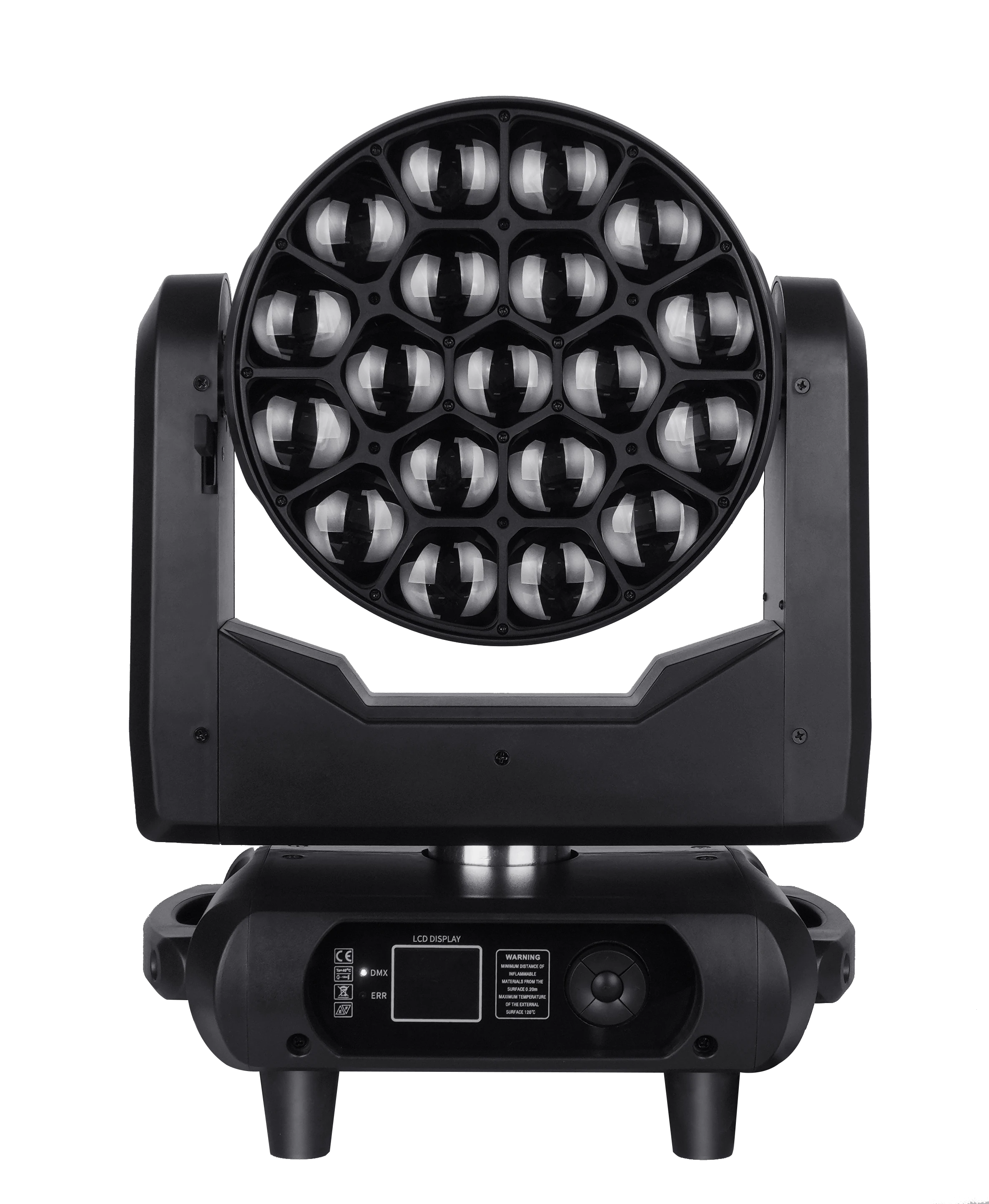
19×40W LED Bee Eye Moving Head Mini
Indoor 19-cell RGBW platform with 4°–60° zoom and extended pixel personalities.
- 19×40W RGBW
- 4°–60° zoom
- Dry indoor use
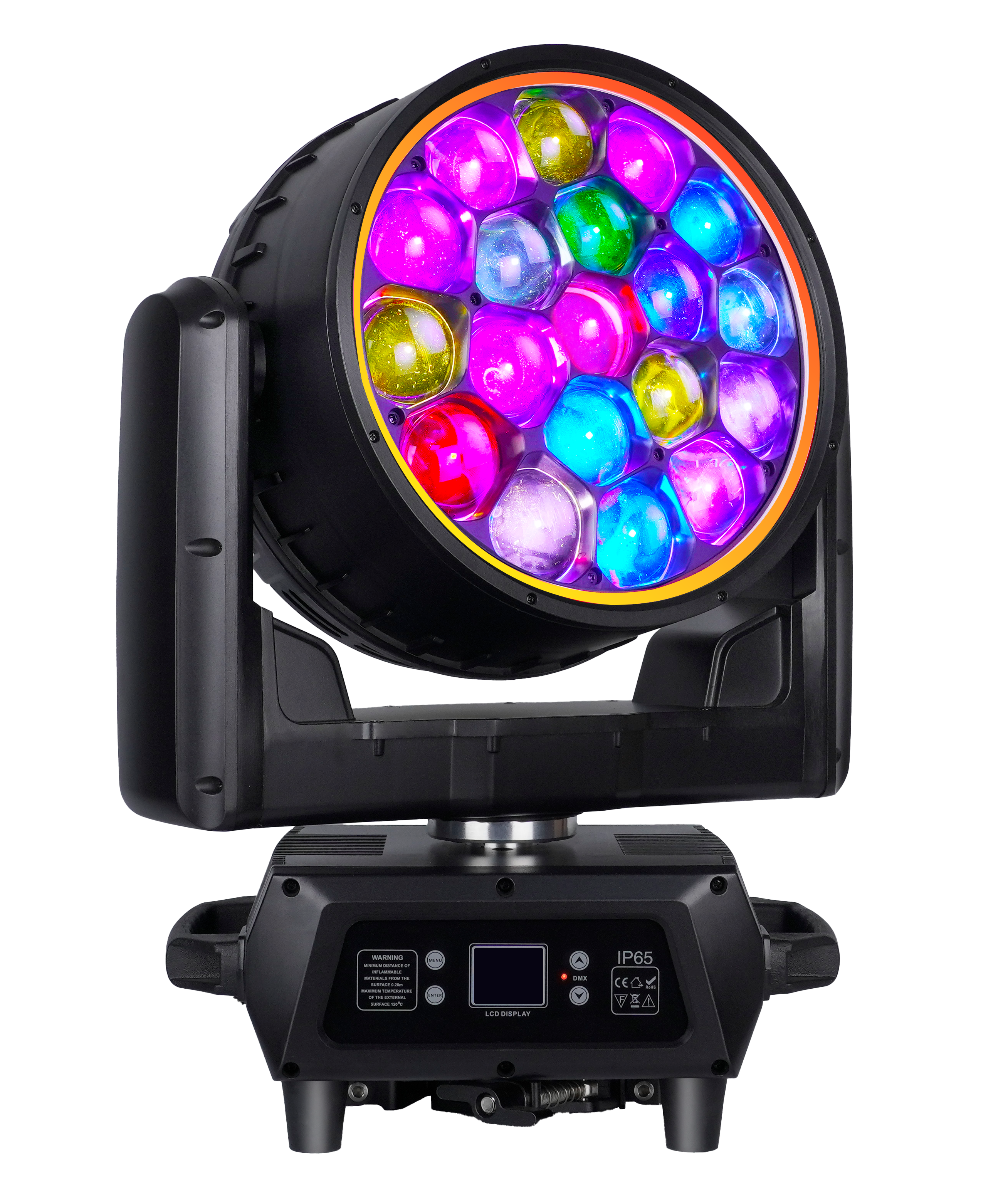
19×40W LED Bee Eye Moving Head Waterproof
IP65 19-cell RGBW platform with 7°–42° zoom and individual-cell control.
- 19×40W RGBW
- 7°–42° zoom
- IP65
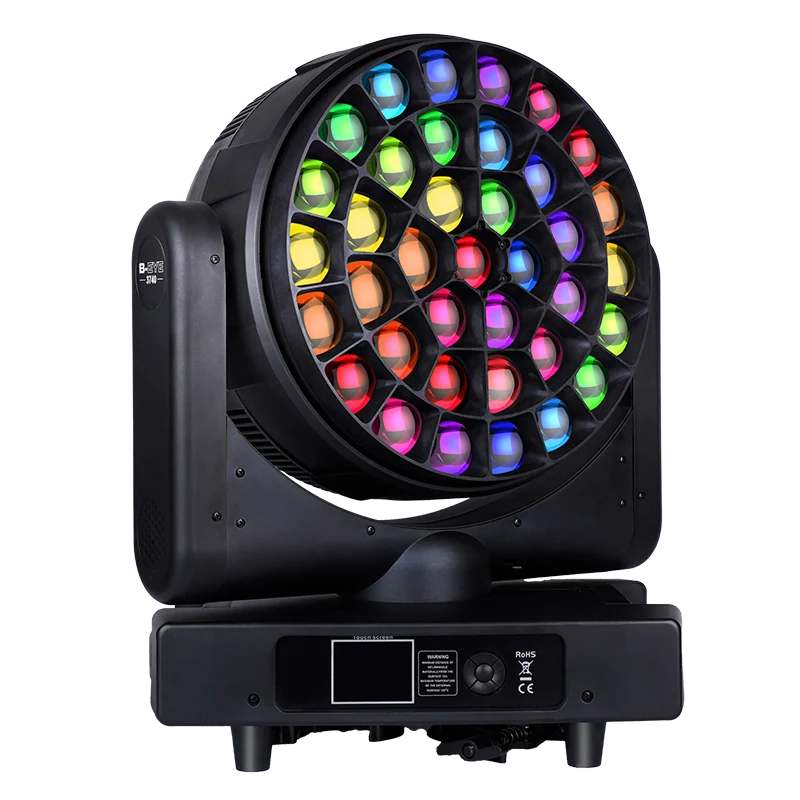
37×40W LED Bee Eye Moving Head
IP20 37-cell RGBW platform with 7°–50° zoom and six DMX personalities.
- 37×40W RGBW
- 7°–50° zoom
- IP20
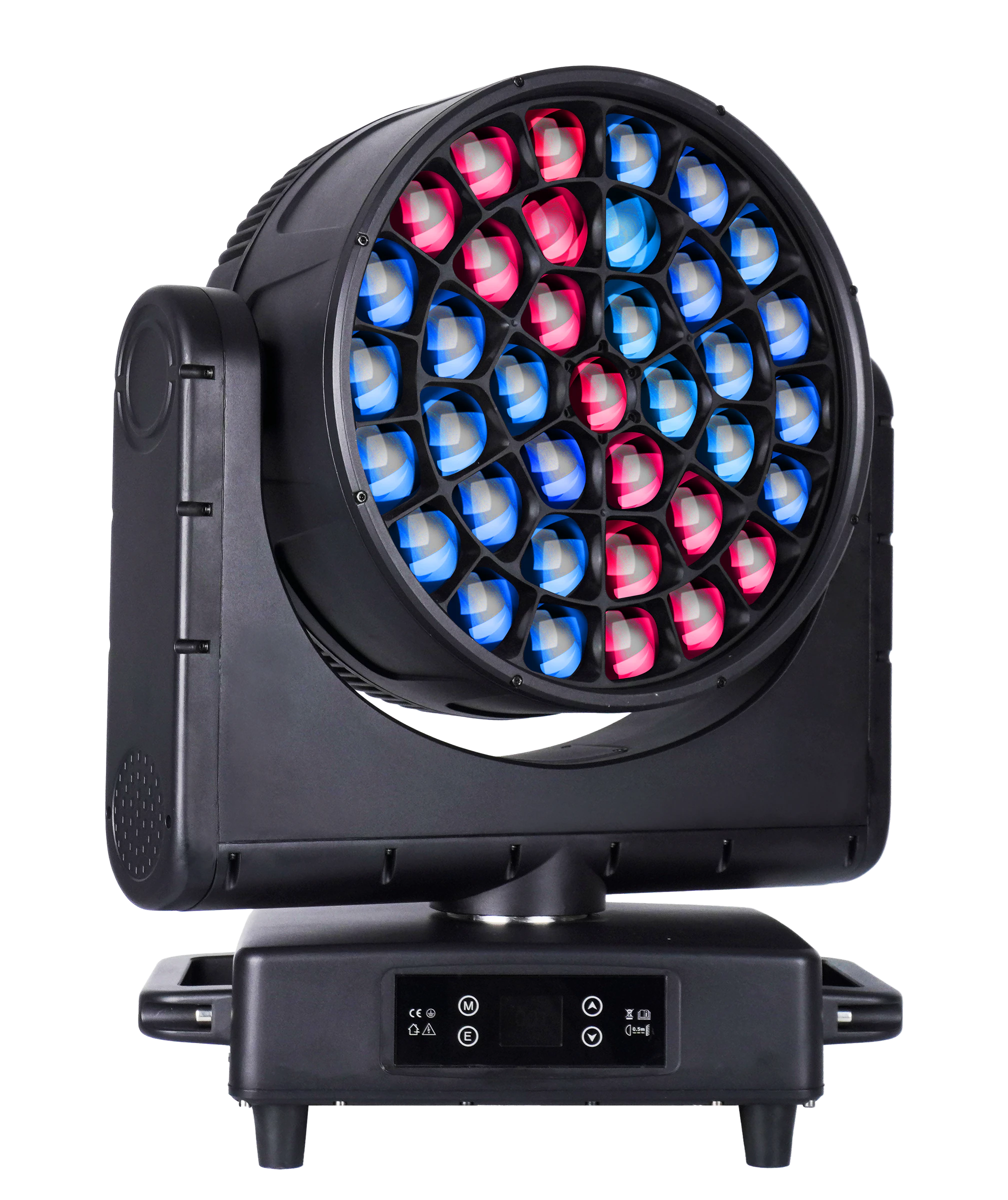
37×40W LED Bee Eye Moving Head
IP65 37-cell RGBW platform with 8°–48° zoom for outdoor-event evaluation.
- 37×40W RGBW
- 8°–48° zoom
- IP65
FREQUENTLY ASKED QUESTIONS