

Movement architecture
Standard 540°/270° movement is not the same as continuous rotation
Finite positioning and continuous spinning solve different programming tasks, even when both appear in one fixture.
A conventional moving head maps the pan and tilt attributes to a defined mechanical travel. A 540° pan range can turn one and a half revolutions between endpoints; a 270° tilt range covers three quarters of a revolution. Fine channels may add positional resolution within that range. Once an axis reaches its limit, the fixture cannot continue through the same direction as an indexed position.
Continuous rotation adds a mode or attribute that drives an axis forward or backward without using a final mechanical endpoint in the same way. Some products provide it on both axes, some on pan only, and some apply continuous rotation to the front lens rather than the whole head. These are not interchangeable functions.
| Control question | Finite indexed movement | Continuous rotation |
|---|---|---|
| Command meaning | Go to a position inside a defined range | Spin in a direction at a selected speed, or use a dedicated continuous range |
| Typical example | 540° pan and 270° tilt with coarse and fine channels | Forward, stop and reverse values on a pan-rotation or tilt-rotation channel |
| At the boundary | Must stop, reverse or choose another path | Can continue rotating while the command remains active |
| Repeatable focus point | Direct positional data is the primary tool | Depends on whether indexed positioning remains available and how spin stops |
| Console profile | Pan, pan fine, tilt and tilt fine | May add separate rotation attributes or special channel ranges |
| Primary show value | Pointing, coverage, presets and controlled sweeps | Uninterrupted spins, continuously changing faces and long movement loops |
The official Ayrton Zonda 9 FX product page provides a clear industry example of a fixture specified with infinite pan and tilt rotation, while its DMX chart separates indexed movement from continuous motor rotation. The example illustrates the control distinction; it is not a substitute for the channel chart of another model.
Path behavior
What happens when a finite axis reaches its boundary
The visible interruption is usually not the endpoint alone; it is the path the fixture must take next.
Imagine a look that keeps turning clockwise. A finite pan axis eventually reaches the end of its travel. To continue the visual idea, the programmer may reverse direction, fade the beam out while the head returns, select an alternate position or use a console shortcut that chooses a shorter route. Every option changes either direction, timing or visibility.
- Boundary reversal
- The axis changes direction after reaching the edge of its allowed range. In a visible continuous-spin cue, the reversal can read as a bounce or interruption.
- Return or unwind move
- The fixture travels back through its range so it can begin another movement. The return may be hidden in blackout or become part of the cue.
Continuous rotation can remove that interruption for a spin-based look, but it does not eliminate every path decision. The console and fixture still need a defined direction, speed, start behavior, stop behavior and transition from continuous rotation back to an indexed position. A sudden stop may not land where a positional preset expects.
Programming applications
What continuous rotation can add to show design
The feature earns its place when the physical movement itself is visible and repeatable in the cue language.
Long rotational loops without a visible bounce
A slow pan orbit can continue through an extended musical section without reversing at a finite boundary. With atmosphere, separate heads or a distinctive illuminated body, the audience sees a stable direction of travel rather than a sweep that repeatedly changes direction.
Double-sided and multi-head structures
A double-sided head can reveal one optical face, rotate through edge-on positions and present the other face as part of the cue. A multi-head bar can combine base rotation with individual head movement, producing waves, fans or changing spatial relationships that depend on the whole structure turning.
Phase-offset groups and symmetrical motion
Console effects can offset otherwise identical movements across a fixture group. The grandMA3 Phaser documentation describes phase as a timing offset for each fixture’s attributes. Applied to a supported continuous-rotation attribute, phase can spread starts or movement relationships across the rig. The result still depends on identical profiles, settings, homing and mechanical response.
- Continuous same-direction rotation through an extended musical phrase.
- Counter-rotating pairs that preserve mirror symmetry without boundary returns.
- A circular or wave pattern whose fixtures start at distributed phase values.
- A double-sided body that intentionally alternates optical faces.
- A multi-head effect where base rotation and head-specific tilt produce layered geometry.
These are programming examples, not claims about an Aolait installation. Recreate the intended cue on the candidate model and console before attaching project value to the feature.
Console workflow
Symmetry and synchronization depend on more than a rotation channel
Two fixtures can receive the same DMX value and still drift visibly if their configuration or mechanical response differs.
For a synchronized group, standardize the firmware, personality, pan and tilt inversion, movement-speed setting, reset state and physical orientation. Store the fixture definition that matches the active mode. A mis-mapped continuous channel can turn a planned stop value into motion or reverse one unit unexpectedly.
DMX provides up to 512 data slots on a link, as summarized by the official ESTA DMX512-A guide. It carries control values; it does not guarantee that multiple motors will accelerate, stop or settle identically. Group behavior has to be measured on physical fixtures over repeated cycles.
Build the patch from the exact mode and keep its footprint in the universe plan. The DMX channel-planning guide covers profiles, universes and expanded personalities. For continuous rotation, add notes for stop ranges, forward and reverse value bands, speed direction and any shortcut or spinout behavior.
Specification boundary
Continuous rotation does not automatically mean better positioning
Rotation range, indexed accuracy, repeatability, speed control and noise are separate performance questions.
An infinite rotation stage light may be excellent at sustained spinning but ordinary at returning to a mark. Another fixture may have limited travel yet repeat a theatre special precisely. Continuous motion describes what happens beyond a normal endpoint; it does not state encoder resolution, backlash, homing tolerance, motor control, acceleration quality or stop consistency.
| Quality | What it means in practice | Sample test |
|---|---|---|
| Indexed accuracy | The head points to the intended commanded position | Return to taped targets from several directions |
| Repeatability | The same cue lands in the same place over many cycles | Run 25–50 position loops and compare beam centers |
| Continuous speed stability | Rotation remains visually even at one command | Film slow, medium and fast rotations for at least two minutes |
| Cross-unit synchronization | A group maintains its planned relationship | Run matched fixtures together through starts, stops and reversals |
| Stop behavior | The axis stops without excessive coast, snap or random final orientation | Test every documented stop range from both directions |
| Noise | Motor and structure remain suitable for the room and cue | Listen at show speeds in the actual mounting orientation |
| Reset recovery | The fixture homes and returns to stored positions predictably | Reset, power-cycle and restore the same cue sequence |
A product page should therefore list continuous capability without turning it into a claim about precision. Project teams should state the pointing tolerance and the rotation look they need, because those requirements may lead to different sample decisions.
Project fit
When infinite rotation adds value—and when it may be unnecessary
Pay for the movement architecture when it supports recurring cues, not because it appears above standard movement in a feature list.
| When it adds value | When it may be unnecessary | Decision question |
|---|---|---|
| Touring looks use long same-direction spins | The rig uses static positions and short sweeps | Does any approved cue cross a finite boundary visibly? |
| Double-sided heads must alternate faces in motion | A single optical face always points toward the stage | Is body orientation part of the audience-facing look? |
| Multi-head structures create rotating waves or fans | The requirement is even wash coverage | Would standard pan, tilt and zoom produce the same result? |
| Clubs and entertainment venues run repeating motion loops | Speech, conference and corporate work prioritizes quiet stable focus | Will continuous motion recur often enough to justify programming and service complexity? |
| Festival or concert atmosphere makes spatial rotation visible | Theatre specials require repeatable marks and controlled transitions | Is sustained rotation more important than precise return to a position? |
| A rental package is sold around distinctive movement effects | Fixed installation users have limited programming time | Can the local console, profile and operator use the feature reliably? |
For architecture-led options, examine the current Aolait Wash FX moving-head range. For a visible multi-lens face whose primary movement remains conventional, compare the Bee Eye range and the Bee Eye pixel-effects guide. The collection label alone never establishes continuous pan or tilt.
Sample acceptance
Run a real movement test before approving the sample
Use the intended console and mount the sample in the orientation that matters to the production.
- Match fixture model, firmware, DMX personality and console profile; label every continuous rotation attribute.
- Test finite indexed pan and tilt across the full documented range before enabling continuous rotation.
- Run forward and reverse rotation at minimum, low, medium and maximum useful speed.
- Approach every stop range from both directions and record coast, snap, final orientation and restart behavior.
- Transition from continuous spin to an indexed position, then return to spin in both directions.
- Run mirrored pairs and groups with 0–360 phase spreads; watch for drift over at least ten minutes.
- Power-cycle and reset the sample, then repeat stored positions and rotation cues.
- Test slow moves in a quiet room and fast moves in the actual rigging orientation.
- Run extended rotation while monitoring mechanical noise, vibration, heat and unexpected pauses.
- Repeat on more than one unit from the proposed production configuration before releasing a batch.
Record short clips with console values visible, and name each file with model, firmware, personality, axis, direction, speed and test number. Mark a result as pass only when the cue remains usable for the planned duration and viewing distance.
Long-run control
Questions for reset, noise, rotating structures and long-term use
Movement approval combines the DMX behavior, mechanical structure and recovery process.
- Which axes support continuous rotation, and is each a separate DMX attribute or a range inside the position channel?
- What are the forward, reverse, stop, shortcut and spinout values in every supported personality?
- Can the fixture move directly from spin to an indexed position, and what orientation does it use after stopping?
- How do power and data pass through each rotating joint, and what inspection or replacement interval applies to that structure?
- What homing sensors, position correction and reset commands are implemented?
- What movement-speed, acceleration or quiet-mode controls are available on the current firmware?
- What normal motor and bearing sounds should operators expect at slow and fast speeds?
- Which parts are field replaceable, and what calibration is required after motor, sensor or rotating-joint service?
- What long-duration rotation test is run at the factory, and under which mounting orientation and speed?
- Which firmware and fixture-profile version should ship with the production batch?
External power, data and safety cables still require normal rigging discipline even when an internal axis rotates continuously. Follow the fixture manual for cable clearance, secondary suspension, mounting orientation and service access. Do not route an external lead where head or yoke movement can catch it.
The right endpoint is a documented cue that survives reset, repeated playback and a long-run sample test. If the show does not use that cue, conventional indexed movement may be the simpler and more controllable choice.
RECOMMENDED PRODUCTS
Models to evaluate against your brief
We organize model-specific product facts and available technical files to support fixture comparison and project planning.
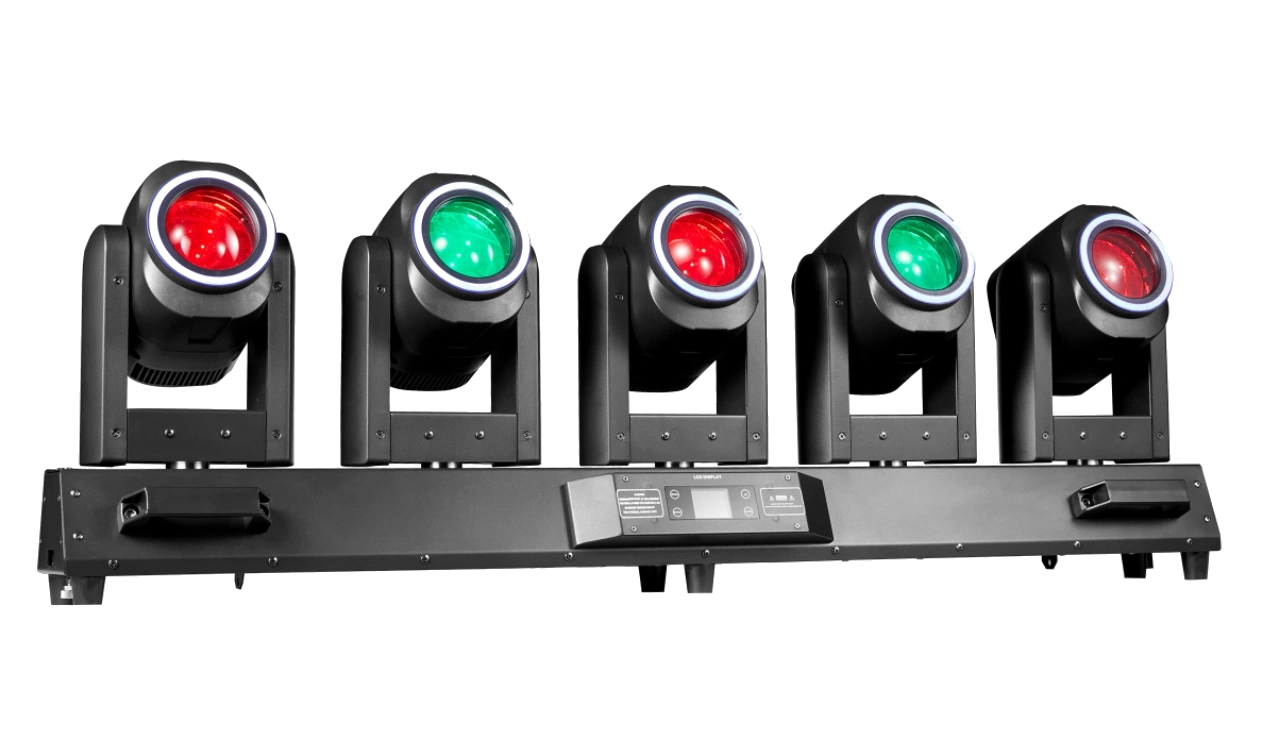
5×80W LED Tornado Moving Head
A five-head Tornado architecture whose documented pan and tilt each provide indexed 0–540° movement, fine adjustment and continuous-rotation effects.
- Five 80W RGBW heads
- Continuous pan and tilt effects
- 28CH / 32CH / 85CH / 88CH
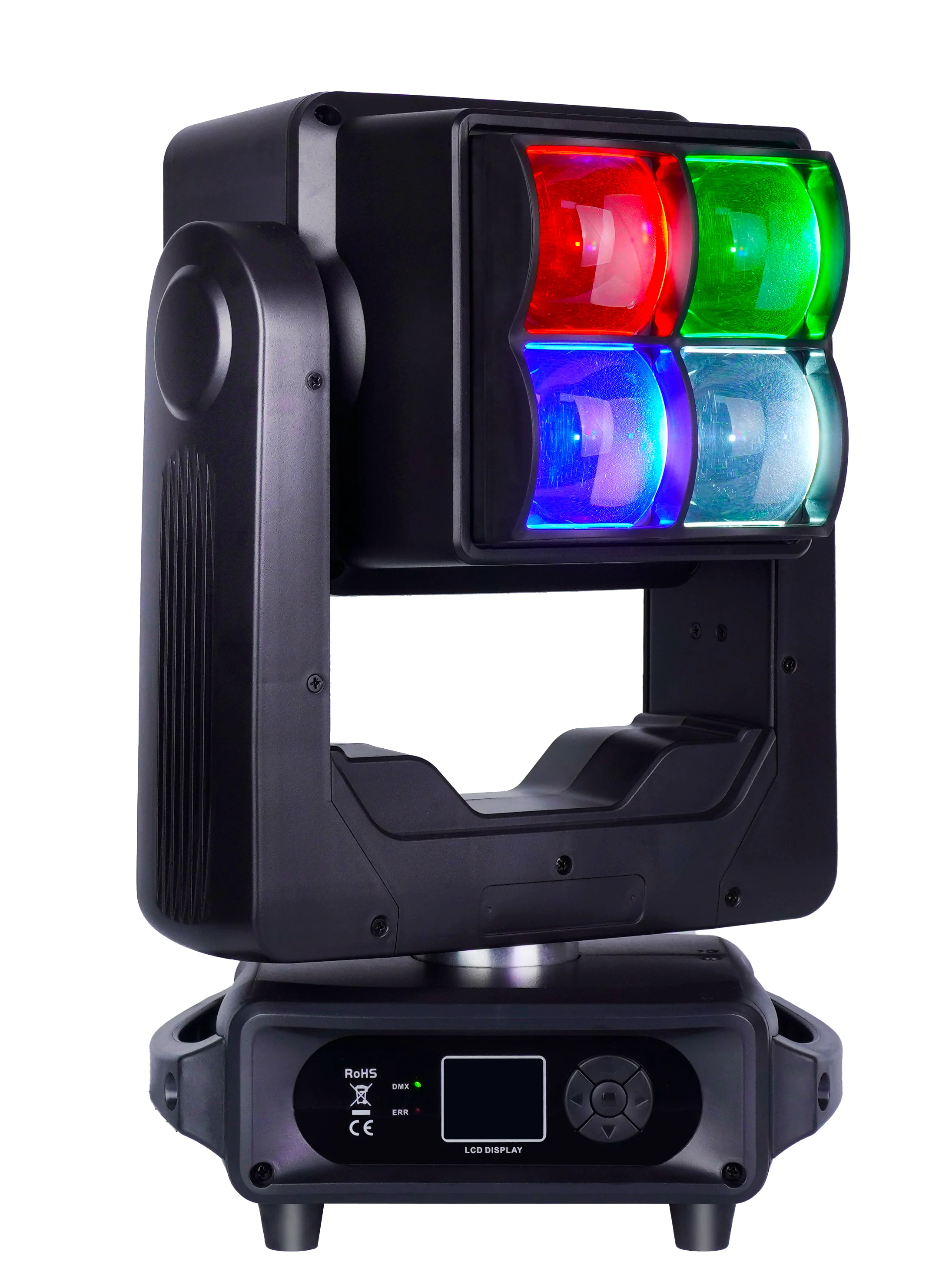
4×60W LED Wash and Strobe Double-Sided Moving Head
A double-sided Wash FX body with documented indexed pan and tilt plus separate continuous-rotation channels for presenting either optical face.
- Double-sided optical structure
- Continuous pan and tilt channels
- 20CH / 34CH / 93CH
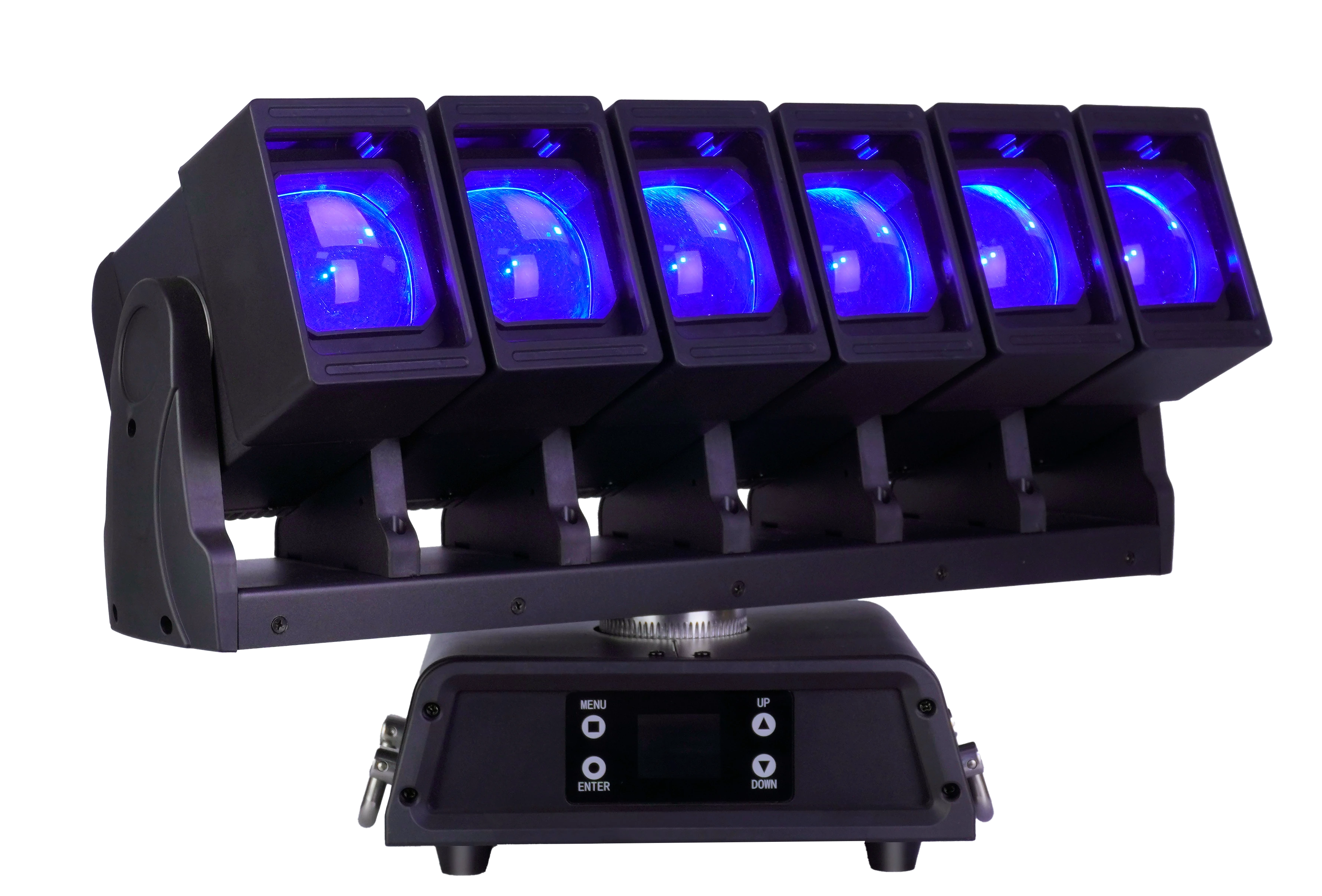
6×60W LED Moving Head Waver
A useful partial-architecture example: the base has documented bidirectional continuous pan, while the six heads provide independent finite tilt and zoom control.
- Six 60W RGBW heads
- Continuous base pan
- Independent head tilt and zoom
FREQUENTLY ASKED QUESTIONS