
Define the workflow
What “Mini” Should Mean for a Small Venue
“Mini” is useful only when it describes how a fixture fits the room and the team's working method.
There is no uniform mini category that guarantees a housing size, output level, optical quality or acoustic behavior. Check the actual envelope, weight, connectors, movement clearance, service access and case density. A compact body still needs a complete optical and operational test.
Stage width is only one input. The same width can require a different plan from a short overhead position than from a rear wall. Lens-to-target distance, fixture angle, ambient light, surface reflectance, camera exposure and cue changes affect the result.
Use the broader LED wash moving head selection guide when the fixture category is still open. Here, the focus is the next set of compact-system decisions.
Geometry before quantity
Start with Stage Width, Throw Distance and Working Zoom
Map each proposed fixture position to a target zone, then calculate a first-pass diameter at the zoom settings the show will actually use.
- Theoretical geometric diameter
- Diameter = 2 × throw distance × tan(angle ÷ 2). Use the full included angle and measure throw along the real lens-to-target path.
| Model and angle | 4 m throw | 6 m throw | 8 m throw |
|---|---|---|---|
| AL740WZ at 3° | 0.21 m | 0.31 m | 0.42 m |
| AL740WZ at 60° | 4.62 m | 6.93 m | 9.24 m |
| C08 at 8° | 0.56 m | 0.84 m | 1.12 m |
| C08 at 50° | 3.73 m | 5.60 m | 7.46 m |
The formula is a planning aid. Usable coverage changes with beam- or field-angle convention, edge falloff, optical state and measurement method; an angled target also stretches the footprint. Mark overlap on a venue drawing, then test narrow, middle and wide positions on the real surface.
For more detail on field planning, see zoom wash moving head stage coverage and apply its placement method to measured positions.
Compare structure and control
AL740WZ and C08 Eco: Two Compact Architectures
These two Aolait formats illustrate why LED count and nominal wattage are not performance rankings.
| Parameter | AL740WZ | C08 Eco |
|---|---|---|
| Product | 7×40W mini LED wash moving head | 19×15W LED wash moving head Eco |
| LED configuration | 7 × 40W RGBW | 19 × 15W RGBW |
| Motorized zoom | 3°–60° | 8°–50° |
| DMX personalities | 18 / 29 / 41 / 57 CH | 16 / 24 CH |
| Cell or zone structure | Seven individually controllable RGBW cells in 57CH; RGB halo | Whole-fixture RGBW in 16CH; three RGBW zones in 24CH |
| Net weight | 6.5 kg | 6.3 kg |
| Power | 350 W rated power | 250 W maximum power |
| Documented environment | Follow the operating conditions for the delivered fixture | IP20; dry indoor use |
AL740WZ uses seven RGBW cells and a separately programmable RGB halo. C08 uses nineteen RGBW emitters and changes from whole-fixture control to three zones. These architectures create different cue choices; neither LED count nor nominal wattage establishes delivered output.
The LED wattage and cell-configuration guide explains why optics, drive conditions, thermal design, color mix and measurement method must accompany nominal component ratings.
Evaluate the whole system
Fewer Fixtures or More Compact Fixtures?
A smaller fixture is not automatically the better route to a smaller rig.
Fewer fixtures may reduce hanging points, addresses, cables, cases and service items, but each unit may cover more area with less redundancy. More compact fixtures can add overlap and cue zones while increasing clamps, safety attachments, cabling, patching time and maintenance points.
- Count available hanging positions and confirm useful aiming angles from each one.
- Draw the overlap at the working zoom, not only at the widest endpoint.
- Check whether fixtures must be repositioned between room layouts.
- Total the DMX, power, signal, transport and routine-service impact.
- Decide whether independent zones improve real cues or only add programming depth.
Choose quantity after a same-position sample test shows the required illumination, blend and cues. A count based on stage width alone ignores trim height, throw, orientation and each position's role.
Plan safe clearances
Rigging, Spacing and Service Access
Compact weight helps planning, but it does not define the capacity of a complete suspension system.
Documented net weight is 6.5 kg for AL740WZ and 6.3 kg for C08. Add clamps, brackets, safety attachments and cables when assessing each point. Match the structure, hardware and suspension method to product instructions and local requirements. Qualified personnel should complete final installation and inspection.
Allow clearance for the complete programmed movement, connector bends, ventilation paths and access to the display. Look for collisions between neighboring heads, scenery, curtains, loudspeakers and cable drops. A tight centre-to-centre spacing may fit at home position but fail during a pan, tilt or zoom cue.
Make cleaning and removal possible without dismantling unrelated equipment. Rental teams should check case orientation, lift path and repeatable bracket position. Never infer a working load, safety factor, minimum distance or hanging method from the word mini.
Address the real personality
Plan the DMX Footprint Before Adding Fixtures
Calculate the universe after choosing the control depth needed by the cue list.
- Fixtures per universe
- floor(512 ÷ channels per fixture), assuming the universe is reserved for identical fixtures in the same personality.
| Model | Personality | Fixtures | Control boundary |
|---|---|---|---|
| AL740WZ | 18CH | 28 | Compact movement, main RGBW and halo control |
| AL740WZ | 29CH | 17 | Movement, main effects, background color and halo control |
| AL740WZ | 41CH | 12 | Fine RGBW, movement, shape effects and halo control |
| AL740WZ | 57CH | 8 | Seven-cell RGBW control plus halo functions |
| C08 | 16CH | 32 | Whole-fixture RGBW control |
| C08 | 24CH | 21 | Three independently controlled RGBW zones |
Compact and extended modes are not functionally equivalent. AL740WZ changes from 28 fixtures at 18CH to 8 at 57CH while adding individual cell control. C08 changes from 32 at 16CH to 21 at 24CH while adding three zones. Select the smallest personality that delivers the cues, then test the console profile.
Use the DMX channel planning guide to document start addresses, universes, personality names and show-file ownership before the fixture count grows.
Use a repeatable method
How to Test Noise Without Inventing a dBA Number
When formal acoustic data is unavailable, record the conditions and compare the real operating states needed by the venue.
Run the same sequence for every candidate
- 01Fix the test position
Use the same fixture location, microphone or listening point, distance, orientation and room.
- 02Record the background
Measure or note ambient noise before power-up, including HVAC and audience-area equipment.
- 03Match the show state
Use the intended brightness, colors, zoom position and available fan setting rather than an idle display state.
- 04Separate operating phases
Record standby, stable output, movement and effect operation as distinct observations.
- 05Repeat with the planned count
Several fixtures can change the combined acoustic result even when one unit seems acceptable.
Log room conditions, distance, cue, duration, fixture software and measurement equipment with the result. Compare candidates only under the same procedure. Do not publish an acoustic label or dBA figure that the test did not measure.
Bring the room into the comparison
Small-Venue Selection Checklist
A useful shortlist connects optical needs, infrastructure and ongoing access.
- Stage width and depth, priority zones, trim positions and sightlines.
- Lens-to-target throw distance for every proposed fixture position.
- Working zoom settings, theoretical diameter and planned overlap.
- Required illumination, color, uniformity and camera behavior measured on site.
- Fixture count, cue roles and any repositioning between venue layouts.
- Structure, hardware, complete hanging load, movement clearance and cable paths.
- DMX personality, addresses, universe capacity and console-profile test.
- Repeatable noise procedure plus cleaning, removal and service access.
Bring the venue drawing, working zooms, cues and control plan into a sample test. This supports a practical comparison without turning nominal LED figures or a size label into a performance claim.
RECOMMENDED PRODUCTS
Models to evaluate against your brief
We organize model-specific product facts and available technical files to support fixture comparison and project planning.
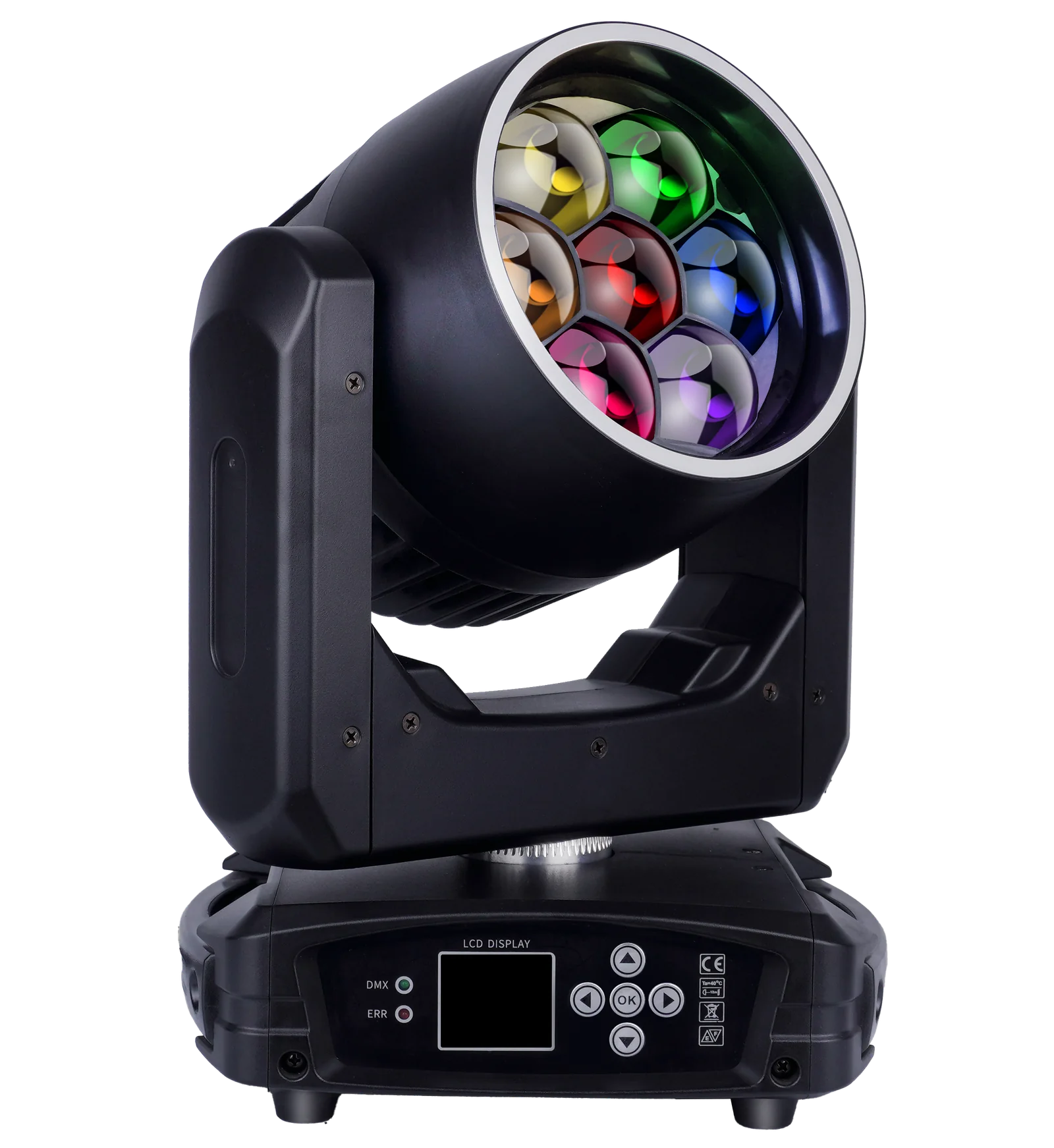
7×40W Mini LED Wash Moving Head
A seven-cell RGBW compact zoom-wash architecture with individual cell control in 57CH mode and a programmable RGB halo.
- 7 × 40W RGBW
- 3°–60° motorized zoom
- 18 / 29 / 41 / 57 CH
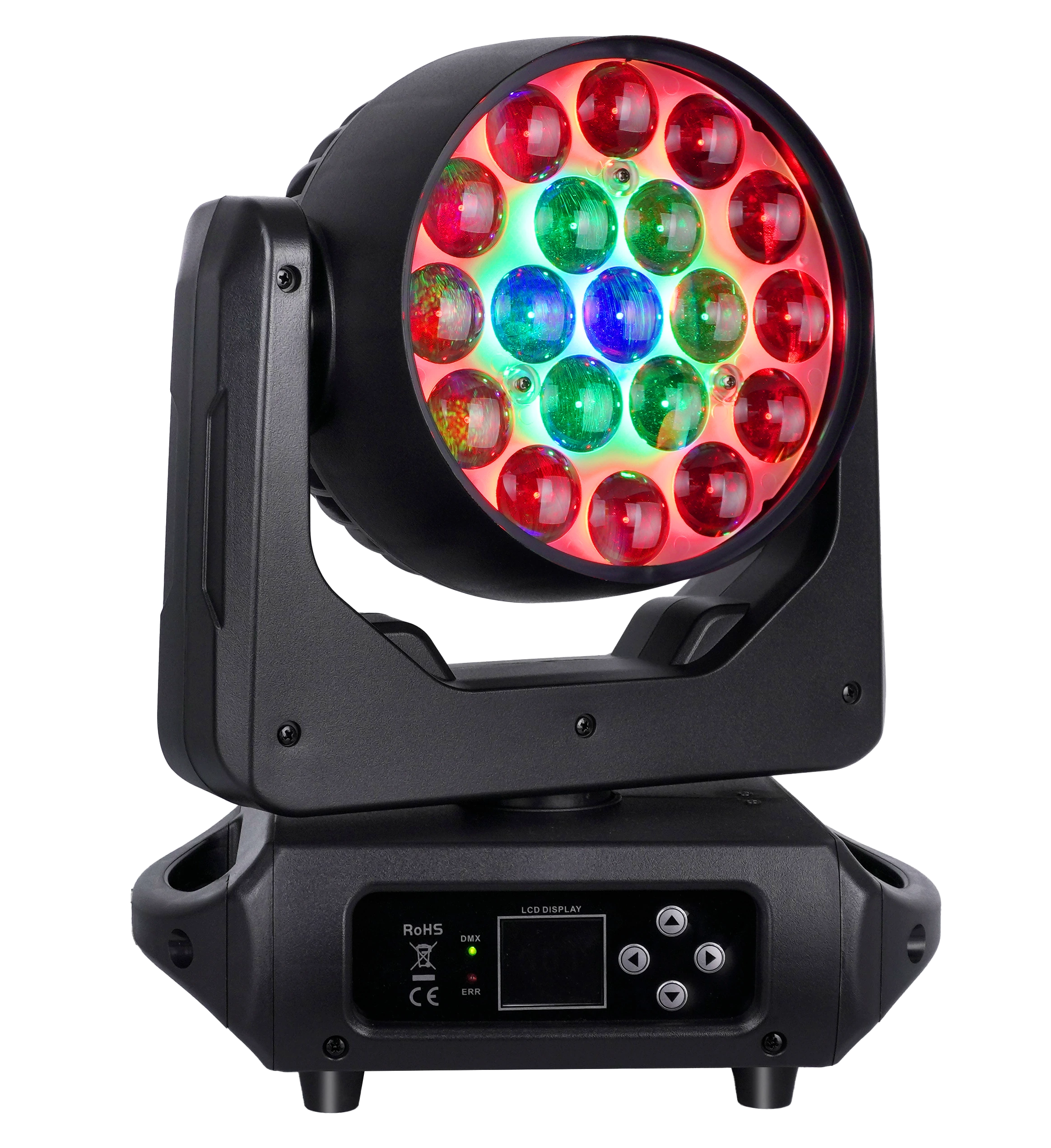
19×15W LED Wash Moving Head Eco
A nineteen-cell RGBW indoor zoom-wash architecture with whole-fixture control in 16CH mode and three zones in 24CH mode.
- 19 × 15W RGBW
- 8°–50° motorized zoom
- 16 / 24 CH · IP20
FREQUENTLY ASKED QUESTIONS