Start with the fixture's job
What Is a Zoom Wash Moving Head?
A Zoom Wash combines motorized positioning, color wash and adjustable angular coverage.
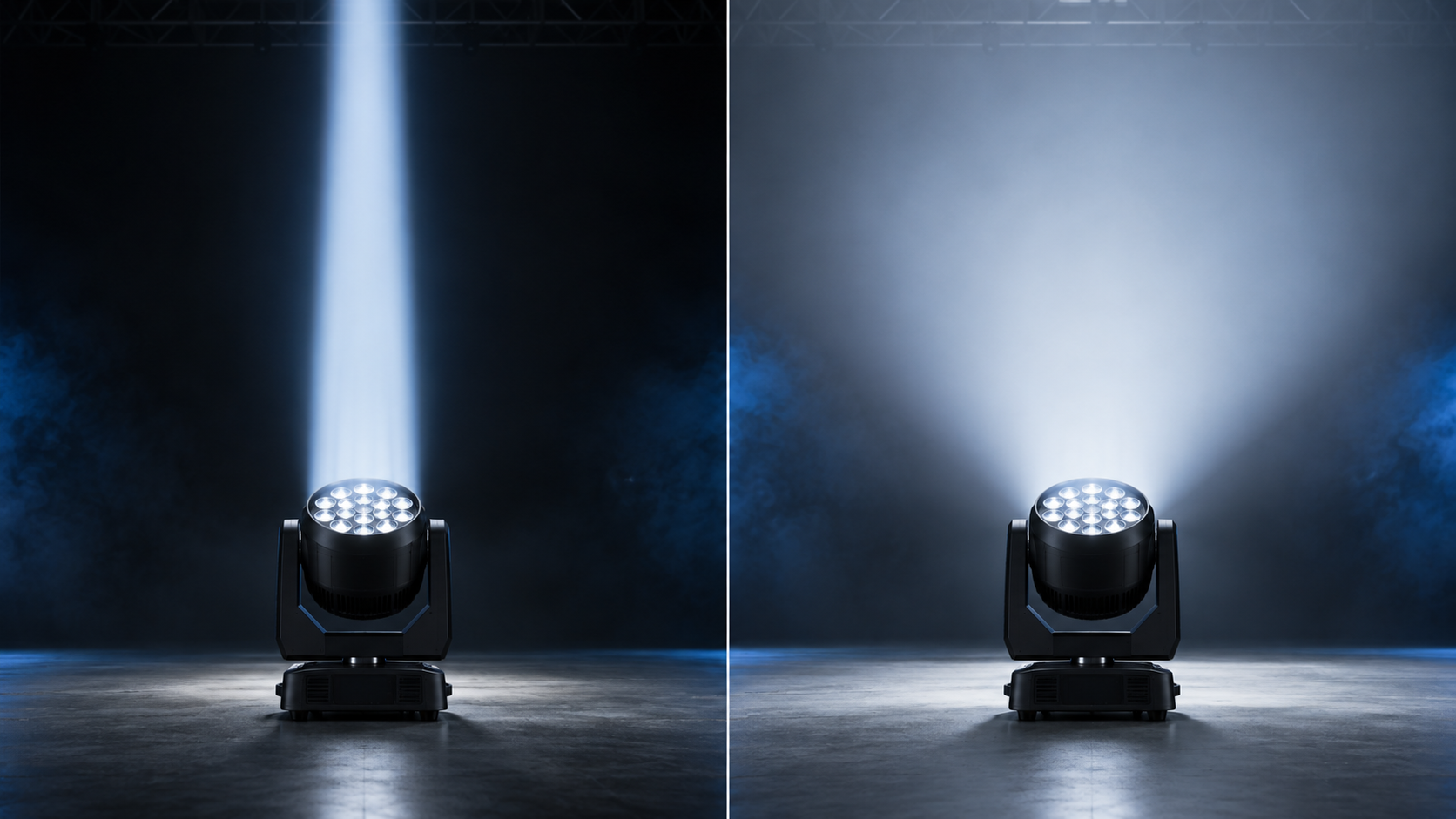
A wash fixture places a colored field on performers, scenery or architecture. A moving head adds motorized pan and tilt. A Zoom Wash adds an optical system whose angular output can be adjusted—normally through the fixture's control protocol when the model supports motorized zoom.
That separates it from a fixed-angle wash, which produces substantially the same nominal spread from every position. A Zoom Wash can adapt its footprint when trim height, throw distance or target size changes. A narrow setting does not automatically give it the focus, center intensity or edge characteristics of a dedicated Beam or Spot.
For current commercial specifications, compare Aolait zoom wash moving heads. This guide explains the optical language and selection method rather than duplicating that category.
Motor, optics and control
How Does Optical Zoom Work?
A motorized optical assembly changes the relationship between the documentation and lens elements.
The resulting distribution becomes narrower or wider. The console sends a value to the zoom channel; the fixture's motor and firmware move the optical assembly to the corresponding position.
The construction varies. A multi-cell LED wash, a single-source RGBL fixture and a rotating-lens effects fixture do not have to use the same lens group, travel or calibration. Compare the documented range and test the current sample instead of assuming every motorized zoom behaves identically.
- Run slow and fast zoom moves in both directions.
- Recall intermediate positions after reset and warm-up.
- Listen for mechanical noise and watch for edge jumps.
- Confirm whether coarse and fine zoom control are documented.
Do not merge different boundaries
Beam Angle vs Zoom Range: What’s the Difference?
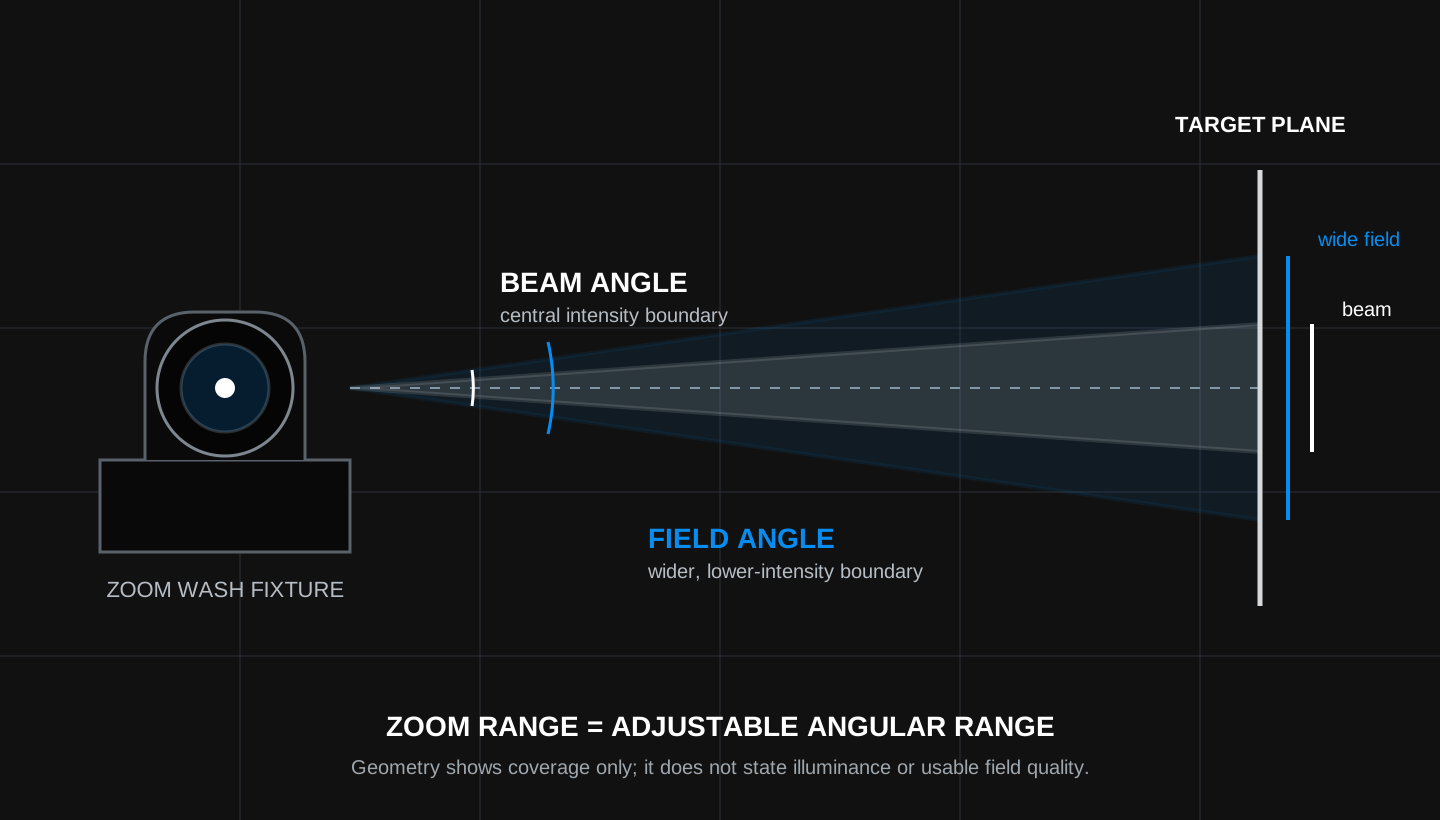
An angle is comparable only when the measurement boundary is identified.
- Beam angle
- The angular width of a distribution at a defined intensity boundary. CIE defines beam angle using the directions where intensity is 50% of the center-beam intensity. The report still needs to state its plane, color state and test conditions.
- Field angle
- A wider, lower-intensity boundary. Its cutoff must be stated, so a field angle cannot be placed beside a beam angle as though they measure the same thing.
- Zoom range
- The adjustable angular interval published for a fixture. It is technically complete only when the documentation identifies whether the endpoints are beam angles, field angles or another stated optical measure.
Use published endpoints carefully
What Does a Zoom Range Like 4°–60° Mean?
AL1650WX and ALP1940WZ both have a documented 4°–60° motorized range.
At 4°, the nominal cone is narrow and covers a smaller area at a given throw. At 60°, it is much wider and covers a larger area. Those endpoints do not state lux, edge quality or uniformity, and two models with the same range can still produce different fields.
Use the stage coverage calculator for geometry, tilt and overlap. Use the Zoom Wash photometrics guide for measured intensity and report quality.
Relative positions, not universal bands
Narrow, Medium and Wide Zoom
The useful position depends on throw, output, trim height, target size and measured field quality.
| Position | Coverage tendency | Useful applications | check |
|---|---|---|---|
| Narrow | Smaller, more concentrated field | Longer throws where output is sufficient; aerial layers; selective backlight | Center intensity, alignment, edge and haze appearance |
| Medium | Balanced area and concentration | General stage zones, corporate events and touring palettes | Uniformity, repeatability and overlap |
| Wide | Larger field at the same throw | Short throws, scenery, cyc and nearby stage areas | Edge falloff, spill and usable illuminance |
Flexibility must solve a real problem
Zoom Wash vs Fixed-Angle Wash
Zoom is not automatically the better choice.
| Factor | Fixed-Angle Wash | Zoom Wash |
|---|---|---|
| Coverage flexibility | Lower | Higher |
| Optical complexity | Lower | Higher |
| Multiple venue sizes | Less flexible | More flexible |
| Rental application | Depends on the assignment | Often useful across changing rooms |
| Cost | Product-dependent | Product-dependent |
| Weight | Product-dependent | Product-dependent |
A fixed-angle wash may be sufficient for a permanent installation with known trim, throw and target area. A Zoom Wash earns its additional mechanism when the same fixture must serve changing placements or field sizes.
Related, not mutually exclusive
Zoom Wash vs Bee Eye
Zoom Wash describes adjustable wash coverage; Bee Eye describes a visible multi-lens architecture.
A Bee Eye fixture may also provide motorized zoom, pixel control or rotating optics. Aolait assigns every published model to one primary family, so a Bee Eye is not duplicated in Zoom Wash simply because it has a zoom channel, and an ordinary wash is not renamed Bee Eye for search coverage.
Compare the Bee Eye Moving Head family when visible cells, rotating optics or pixel effects are central to the specification.
Start with the installation
Which Zoom Range Do You Need?
There is no universal best range.
Match the optical range to the work
- 01Small venue or club
Shorter throws and lower trims often favor usable wide coverage, compact dimensions and manageable noise.
- 02Ballroom or corporate event
Changing room sizes and rigging points reward repeatable intermediate zoom positions.
- 03Theatre
Compare edge quality, color, low-level dimming, fan behavior and coverage from the actual positions.
- 04Rental company
One fixture can serve several venue sizes when its full range remains useful and repeatable.
- 05Touring
Store zoom palettes for changing stages and check reset, profile and firmware consistency.
- 06Large stage
Evaluate output, quantity, overlap and photometric data together; range cannot replace intensity.
- 07Outdoor event
Treat zoom, output and documented ingress protection as separate gates.
For exposed work, consult IP20 vs IP65 moving head wash selection before specifying a fixture.
Current public range
Current Aolait Zoom Wash Product Matrix
The matrix uses current public product records. Values that cannot be stated consistently remain not published.
| Model | LED / color | Zoom | Protection | Pixel / zone control | Weight |
|---|---|---|---|---|---|
| C08 | 19×15W RGBW | 8°–50° | IP20 | 3 RGBW zones | 6.3 kg |
| AL150WX | 1×150W RGBL | 19°–27° | Indoor; no IP claim | 24 RGB effect pixels | 4.4 kg |
| AL1019WZ | 19×15W RGBW | 8°–63° | IP20 | 3 RGBW zones | 7.5 kg |
| AL740WZ | 7×40W RGBW | 3°–60° | Not published | 7 cells + halo | 6.5 kg |
| AL3715WZ | 37×15W RGBW | 5°–60° | Not published | 4 / 7 areas | 13.5 kg |
| AL1650WX | 16×50W RGBL | 4°–60° | IP65 | 16 cells + RGB halo | 21 kg |
| AL1950WX | 19×50W RGBL | 6°–55° | Not published | 19 cells + RGB backlight | 17 kg |
| ALP1940WZ | 19×40W RGBW | 4°–60° | IP65 | 3 zones + halo/background | 14 kg |
Compare the complete system
What Else Matters Besides Zoom Range?
Do not select between two fixtures on endpoint numbers alone.
Compare the LED engine, measured output, stated angle definition, color system, color consistency, dimming, cell or zone control, movement, DMX modes, RDM, ingress protection, noise, weight, dimensions, power, operating limits, service access, cases, spare parts and current certification documents.
How to compare two Zoom Wash moving heads
- 01Check the angle
Record the zoom range and whether it is a beam angle, field angle or undefined published angle.
- 02Compare photometrics
Ask what was measured, at what distance, color state and optical position.
- 03Compare the engine
Compare LED source, color system, dimming and cell or zone structure.
- 04Confirm control
Match DMX modes, RDM and profile availability to the programming workflow.
- 05Check environment and handling
Compare IP rating, weight, maximum power, noise and case requirements.
- 06Plan support
Confirm spare parts, service scope, firmware records and current technical files.
RECOMMENDED PRODUCTS
Models to evaluate against your brief
We organize model-specific product facts and available technical files to support fixture comparison and project planning.
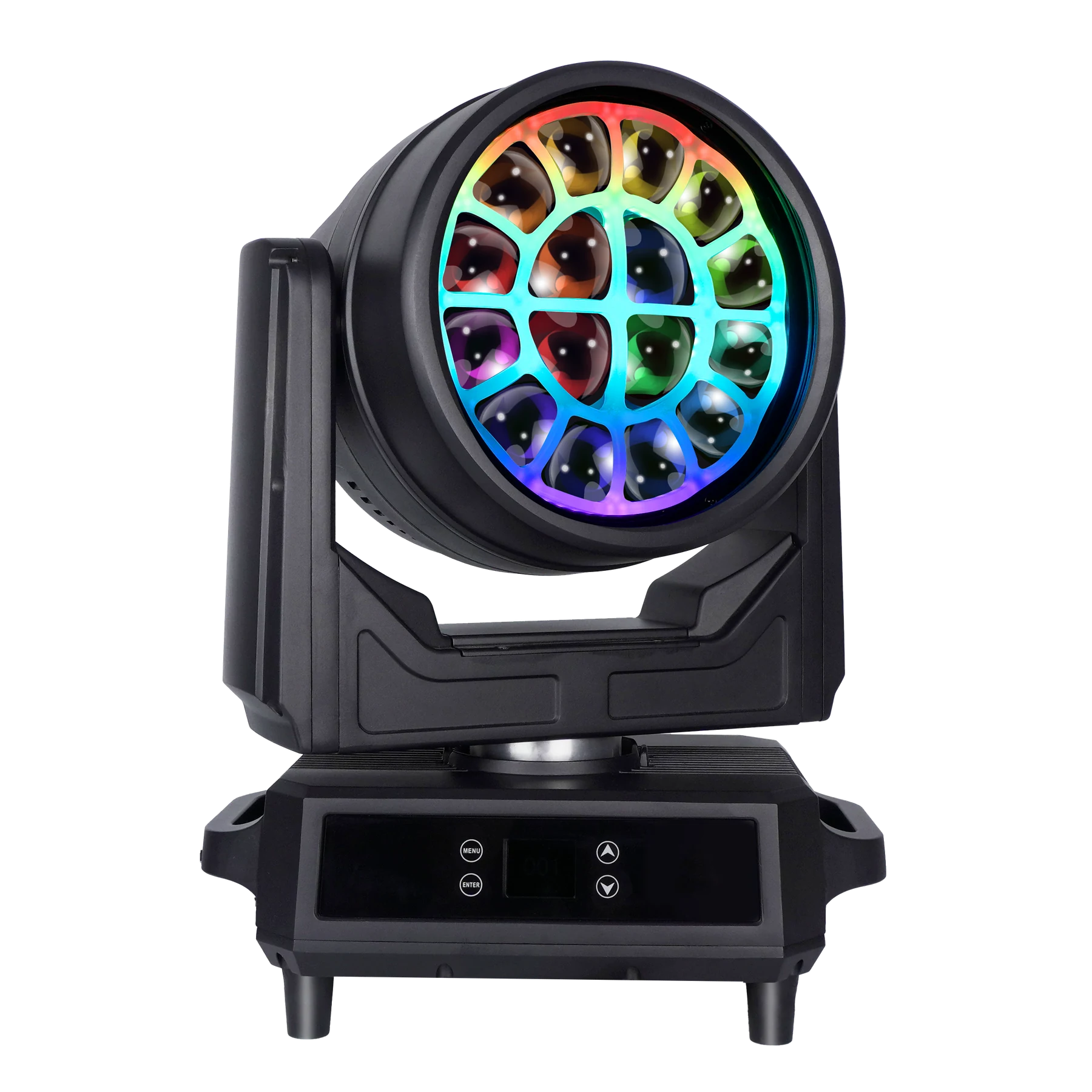
16×50W LED Wash Moving Head IP65
A documented 4°–60° RGBL Zoom Wash example with individual main-cell control and IP65 protection.
- 16 × 50W RGBL
- 4°–60° motorized zoom
- 24 / 44 / 48 / 113CH
- 21 kg
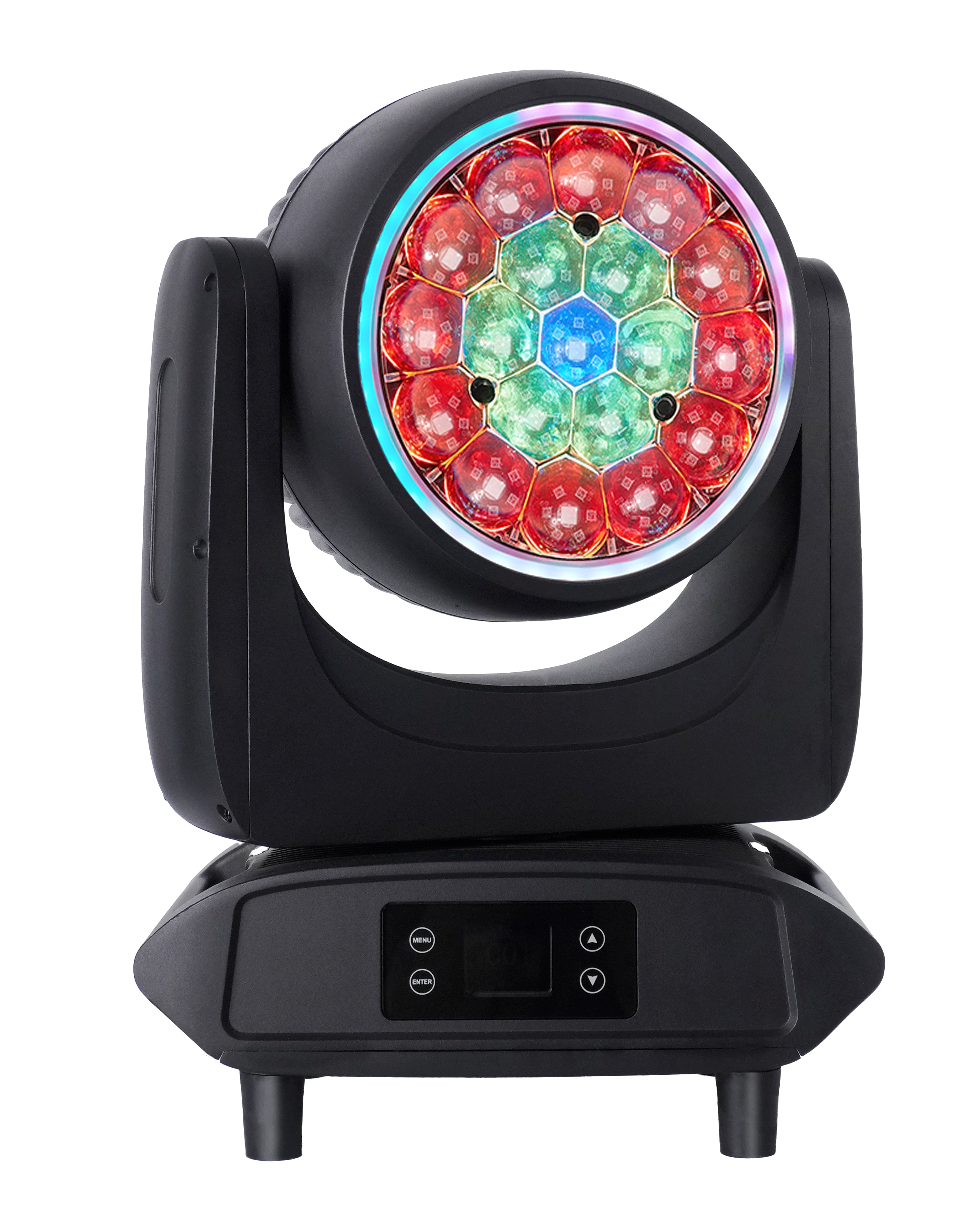
19×40W LED Moving Head Mini IP65 Waterproof
A compact 14 kg IP65 Zoom Wash with a documented 4°–60° range, three RGBW zones and layered face effects.
- 19 × 40W RGBW
- 4°–60° motorized zoom
- IP65
- 14 kg
FREQUENTLY ASKED QUESTIONS